
The European office market continues to operate in a challenging environment, marked by moderate economic growth, geopolitical uncertainty and persistently high interest rates. Against this backdrop, both occupiers and investors remain cautious. While leasing activity remains under pressure and rising yields are once again weighing on capital values, office investment is showing a degree of resilience, with volumes up 7% over the first nine months of the year. The market is becoming increasingly selective and polarised, with demand continuing to focus on prime assets in the best locations.
Take-up remains subdued
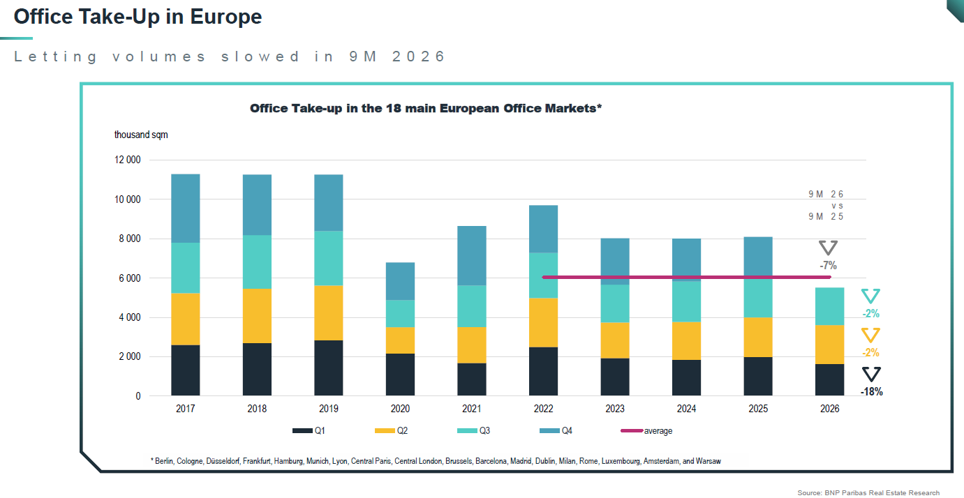
In the third quarter of 2026, leasing activity slowed slightly across Europe, with take-up down 2% compared with the third quarter of 2025. Over the first nine months of the year, take-up reached 5.51 million sqm across the 18 main European markets*, down 7% year-on-year and 9% below the five-year average. This trend notably reflects a decline in large transactions across many markets. In an economic and financial environment that remains uncertain, occupiers continue to exercise caution, increasingly favouring smaller spaces and higher-quality buildings.
Trends nevertheless vary considerably across Europe’s major markets.
In Paris, take-up fell by 18%, weighed down by a decline in transactions above 5,000 sqm (-30%), while the small and medium-sized segment proved more resilient (-8%).
London also recorded a 6% decline, although the 771,000 sqm of take-up remains 6% above the five-year average. The market particularly benefited from large transactions, with 22 deals above 5,000 sqm recorded since the beginning of the year.
The six main German markets remained broadly stable (-1%), although disparities between cities remain significant. Berlin and Munich stood out, with year-on-year increases of 49% and 19% respectively, taking activity to 12% and 8% above their respective five-year averages. This momentum was notably supported by several large transactions, including significant owner-occupier deals. Conversely, take-up fell by 12% in Hamburg and 40% in Frankfurt, where healthy activity in the mid-sized segment was insufficient to offset the absence of major transactions.
Elsewhere in Europe, performances were similarly mixed. Amsterdam (-41%), Milan (-19%) and Madrid (-11%) recorded significant declines, while Brussels (+22%) and Warsaw (+19%) posted more positive trends.
Download the press release for more insights
Read on for further details on vacancy rates, prime rents and other key findings from the Q3 European office market analysis.

